 By
By Lemon balm (Melissa officinalis) is a fragrant member of the mint family known for its fresh citrus aroma and gentle lemon flavor. Native to parts of Europe, the Mediterranean, and western Asia, the herb has a long history of traditional use and is now grown in gardens around the world.
Today, lemon balm is best known as a caffeine-free herbal tea and a popular ingredient in extracts, tinctures, supplements, and aromatherapy products. It contains naturally occurring plant compounds such as rosmarinic acid and aromatic oils that have attracted scientific interest, particularly for their potential roles in relaxation, sleep, digestion, and cognitive function.
Beyond its traditional herbal uses, lemon balm is surprisingly practical. Fresh leaves can flavor salads, fruit, smoothies, and drinks, while dried leaves make an aromatic tea. Below, we’ll look at what research actually says about lemon balm benefits, how to use the herb, possible side effects and interactions, and how to grow and harvest your own.
What Is Lemon Balm?
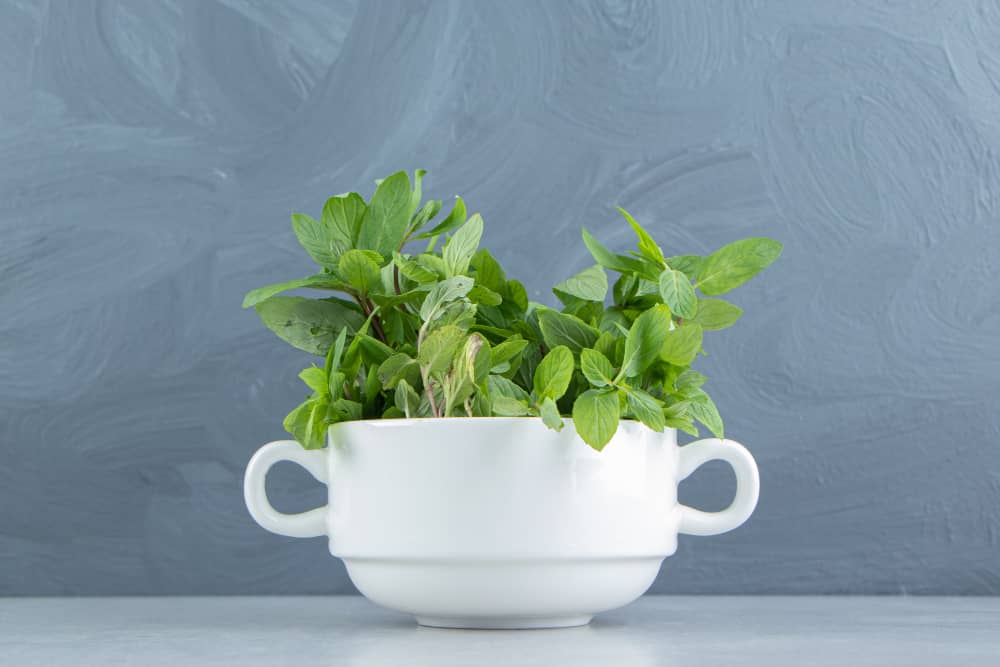
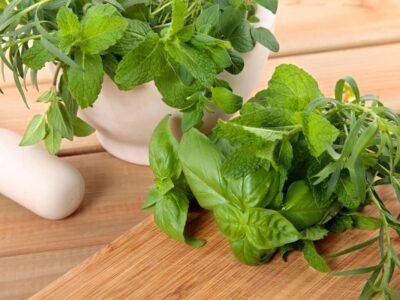
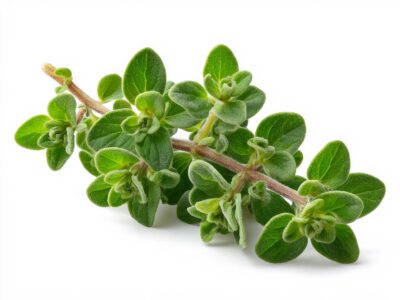
Lemon balm (Melissa officinalis) is a perennial herb in the mint family (Lamiaceae). It has soft, slightly wrinkled green leaves and small white flowers, but its most recognizable feature is the fresh lemon scent released when the leaves are rubbed or crushed.
Despite the name, lemon balm isn’t related to the lemon tree. Its citrus-like fragrance comes from aromatic compounds in the leaves, including citral, citronellal, and geraniol.
The plant typically grows about 12–36 inches (30–90 cm) tall and does well in temperate climates. Like many members of the mint family, lemon balm can spread enthusiastically once established, which is why some gardeners prefer keeping it in containers.
Both fresh and dried leaves are used. Fresh lemon balm has a delicate lemon-mint flavor that works well in salads, fruit dishes, drinks, and desserts, while dried leaves are most commonly brewed as herbal tea. Lemon balm is also sold as tinctures, extracts, capsules, and essential oil.
Its combination of culinary uses, traditional herbal applications, and easy-growing nature has helped Melissa officinalis remain popular long after its earliest recorded uses.
Lemon Balm Quick Facts
| Feature | Details |
|---|---|
| Botanical name | Melissa officinalis |
| Common names | Lemon balm, balm, sweet balm |
| Plant family | Lamiaceae (mint family) |
| Plant type | Herbaceous perennial |
| Native range | Europe, the Mediterranean region, and western Asia |
| Typical height | 12–36 inches (30–90 cm) |
| Flavor | Mild lemon with subtle herbal and mint notes |
| Aroma | Fresh, citrusy, and slightly sweet |
| Parts commonly used | Primarily the leaves |
| Common uses | Herbal tea, cooking, extracts, tinctures, supplements, and aromatherapy |
| Notable compounds | Rosmarinic acid, flavonoids, citral, citronellal, and geraniol |
| Bloom period | Summer |
| USDA hardiness | Commonly grown as a perennial in Zones 4–9 |
| Growing difficulty | Easy |
| Best time to harvest | Before or around early flowering, when leaves are highly aromatic |
History and Traditional Uses of Lemon Balm
Lemon balm (Melissa officinalis) has a remarkably long history. The herb has been cultivated and used in Europe and the Mediterranean region for more than 2,000 years, both as a medicinal plant and for its pleasant lemon fragrance.
Even its name reflects an old connection with bees. Melissa comes from the Greek word for honeybee, and lemon balm’s small flowers are particularly attractive to bees and other pollinators. Historically, the herb was sometimes planted around beehives, a practice that helped strengthen its association with bees.
Lemon balm appears in classical herbal writings, including those associated with the Greek physician Dioscorides. Centuries later, it became a familiar plant in European monastery and medicinal gardens, where the leaves were prepared in teas, tonics, and other herbal remedies.
Another interesting chapter in its history is Carmelite Water, an aromatic preparation associated with Carmelite religious communities in Europe and especially popular from the 17th century onward. Recipes varied, but lemon balm was traditionally combined with other fragrant herbs and spices to make the preparation.
Traditional uses of lemon balm centered largely on calming the body and settling the stomach. Herbalists used it for:
- Occasional nervousness and restlessness
- Supporting relaxation and sleep
- Digestive discomfort after meals
- Bloating and gas
- Headaches and general discomfort
- Aromatic and topical preparations
Lemon balm wasn’t limited to the medicine cabinet, either. Fresh leaves flavored teas, wines, syrups, and vinegars, while their lemony fragrance made the plant useful in scented waters, herbal baths, sachets, and other household preparations.
Some of these traditional uses have since attracted scientific attention, particularly lemon balm’s possible effects on stress, sleep, digestion, cognitive function, and cold sores. Research is stronger in some areas than others, however, so historical use shouldn’t automatically be interpreted as proof of a health benefit. The European Medicines Agency’s assessment of Melissa Leaf likewise distinguishes long-standing traditional use from stronger clinical evidence. We’ll separate the tradition from the clinical evidence in the sections below.
Active Plant Compounds in Lemon Balm
Lemon balm contains a complex mixture of plant compounds that contribute to its aroma, flavor, and potential biological effects. The exact chemical profile isn’t fixed—it can change with the variety of the plant, growing conditions, harvest time, drying, storage, and the way the herb is prepared.
One of the most studied compounds in Melissa officinalis is rosmarinic acid, a polyphenol also found in herbs such as rosemary, sage, and mint. Researchers have investigated it for its antioxidant and other biological properties, and it is frequently discussed in studies examining lemon balm extracts.
The leaves also contain flavonoids, phenolic acids, triterpenes, and small amounts of volatile aromatic compounds.
| Compound or Group | Examples | Why It’s of Interest |
|---|---|---|
| Rosmarinic acid | Rosmarinic acid | One of lemon balm’s best-studied polyphenols; known for antioxidant activity |
| Flavonoids | Luteolin, apigenin and related compounds | Contribute to the plant’s overall polyphenol and antioxidant profile |
| Phenolic acids | Caffeic acid and related compounds | Naturally occurring antioxidant compounds found in many plants |
| Volatile compounds | Citral, citronellal, geraniol | Responsible for much of lemon balm’s characteristic citrus aroma |
| Triterpenes | Ursolic acid, oleanolic acid | Plant compounds being studied for a variety of biological activities |
| Tannins | Various plant tannins | Contribute partly to the herb’s mildly astringent character |
Why Preparation Matters
A cup of homemade lemon balm tea isn’t chemically identical to a standardized extract used in a clinical trial. Hot water extracts some compounds efficiently, while tinctures, essential oils, and concentrated supplements can have very different chemical profiles.
Freshness matters too. Lemon balm’s delicate volatile compounds gradually decline after harvesting and drying, which is one reason freshly crushed leaves smell noticeably stronger than older dried herb.
This distinction becomes important when looking at lemon balm benefits. If a study used a specific standardized extract, we shouldn’t assume that drinking one cup of lemon balm tea will produce the same effect or provide the same amount of active compounds.
Potential Lemon Balm Benefits
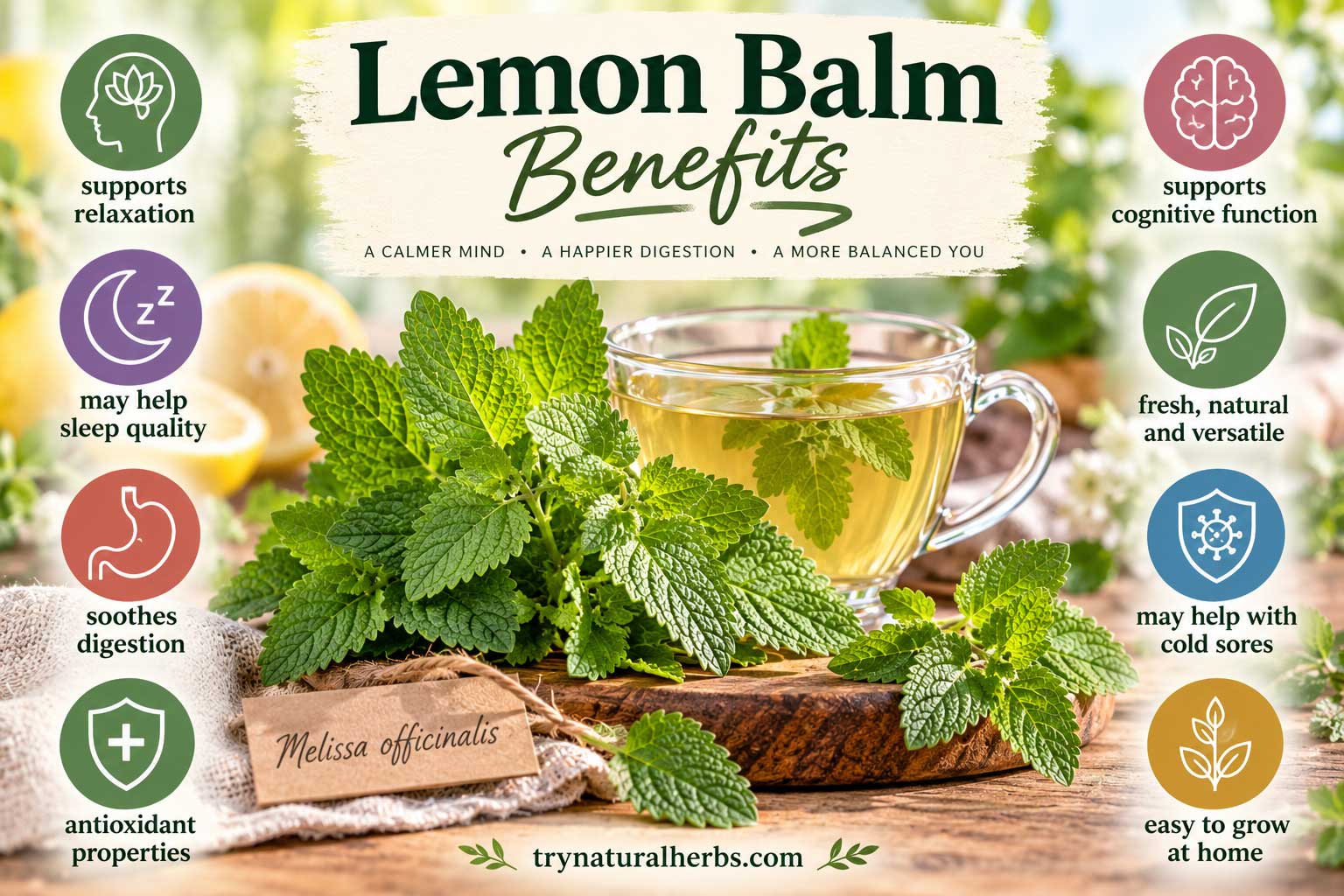
Lemon balm has been used traditionally for everything from nervousness to digestive discomfort, but not every historical use has the same level of scientific support. Modern research has focused mainly on its possible effects on stress and relaxation, sleep, cognitive function, digestive symptoms, and cold sores.
Another important distinction is the form of lemon balm being studied. A standardized extract used in a clinical trial can be much more concentrated than homemade lemon balm tea, while topical creams are entirely different from oral supplements. Results from one preparation shouldn’t automatically be applied to another.
Here’s where the evidence currently stands:
| Potential Benefit | What the Research Suggests | Evidence at a Glance |
|---|---|---|
| Stress and relaxation | Small human studies suggest certain lemon balm preparations may reduce feelings of stress or increase calmness | Promising, but limited |
| Sleep | Some studies report improved sleep-related symptoms, although lemon balm is often combined with valerian or other herbs | Limited |
| Cognitive function | Standardized extracts have been studied for effects on attention, memory, and mood, with mixed but interesting results | Preliminary |
| Digestive comfort | Lemon balm has a long traditional history for indigestion, gas, and abdominal discomfort, but clinical evidence for lemon balm alone is limited | Mostly traditional evidence |
| Cold sores | Topical preparations containing lemon balm extract have been studied for recurrent herpes simplex cold sores | Some supportive clinical evidence |
| Antioxidant activity | Lemon balm contains rosmarinic acid and other antioxidant compounds, although laboratory antioxidant activity doesn’t automatically translate into a specific health benefit | Established chemically; clinical significance unclear |
What Lemon Balm Hasn’t Been Proven to Do
It’s easy to find much bigger claims about lemon balm online, including claims that it can treat thyroid disease, lower cholesterol, control diabetes, prevent heart disease, cure anxiety, or fight serious infections.
Current evidence doesn’t justify presenting lemon balm as a proven treatment for those conditions.
The most responsible way to look at lemon balm benefits is to separate promising research from traditional use and laboratory findings. The next sections take a closer look at the areas with the most relevant evidence and explain what the studies actually tell us.
Lemon Balm for Stress and Relaxation
Lemon balm’s reputation as a calming herb goes back centuries, but this is also one of its traditional uses that has received some attention in human research.
Small clinical studies have tested Melissa officinalis in different forms, including standardized extracts and lemon balm incorporated into foods or beverages. Some have reported reductions in self-rated stress, nervousness, or anxiety-related symptoms, along with increases in feelings of calmness.
In one small controlled study, healthy adults took standardized lemon balm extract before completing a laboratory stress test. Researchers reported that one dose increased self-rated calmness and reduced alertness compared with placebo. The results were interesting, but the study was small and looked at short-term effects rather than chronic stress or an anxiety disorder.
Another small study tested lemon balm extract added to foods and found changes in some measures of mood and cognitive performance. Again, the results suggest that lemon balm may have acute calming effects, but they don’t establish it as a treatment for anxiety.
How Might Lemon Balm Affect Relaxation?
One proposed explanation involves GABA (gamma-aminobutyric acid), an inhibitory neurotransmitter involved in regulating nervous-system activity.
Laboratory research suggests that compounds in lemon balm, including rosmarinic acid, may influence enzymes involved in GABA metabolism. This is one possible mechanism behind lemon balm’s calming reputation, but laboratory findings don’t prove that the same effect occurs to a clinically meaningful degree in people drinking lemon balm tea.
That’s an important distinction. Most of the more interesting human research has involved measured extracts, not an ordinary cup of homemade tea.
Using Lemon Balm for Relaxation
If you enjoy herbal tea, lemon balm is an easy caffeine-free option for an evening wind-down routine. Fresh or dried leaves can also be combined with herbs such as chamomile or lavender for flavor.
Concentrated extracts and supplements are different. Their strength varies considerably, so the manufacturer’s directions—and any relevant medication precautions—matter more than a general herbal-tea recommendation.
Lemon balm may be a useful complement to healthy stress-management habits, but persistent anxiety, panic attacks, or stress that interferes with daily life shouldn’t be managed with an herb alone.
Lemon Balm and Sleep
Lemon balm is also closely associated with sleep, although the evidence here requires a little more caution.
Many of the studies commonly cited for sleep didn’t test lemon balm by itself. Instead, researchers used combinations of lemon balm and valerian, making it difficult to determine which herb was responsible for any improvement.
Some small studies of these combinations have reported improvements in restlessness or sleep-related symptoms. Other research has explored lemon balm preparations in people experiencing sleep difficulties alongside stress or anxiety symptoms. The findings are encouraging enough to justify further study, but the evidence isn’t strong enough to call lemon balm a proven treatment for insomnia. A more recent placebo-controlled study has also investigated a standardized lemon balm extract for sleep quality.
Does Lemon Balm Make You Sleepy?
It may promote relaxation or cause drowsiness in some people, particularly when taken in concentrated forms. That’s different from saying lemon balm acts as a sleeping pill.
A warm cup of lemon balm tea can still make sense before bed for a simpler reason: it’s naturally caffeine-free and can become part of a consistent wind-down routine.
If you want to try it, drinking a cup roughly 30–60 minutes before bed is a practical approach rather than a medically established requirement.
People taking sedatives, sleep medications, or other medicines that cause drowsiness should check with a healthcare professional before using concentrated lemon balm products, since combining calming substances could potentially increase sedation.
For ongoing insomnia, frequent nighttime waking, or excessive daytime sleepiness, it’s better to investigate the underlying cause rather than relying on lemon balm or another sleep herb.
Lemon Balm for Digestion
Lemon balm has a long history as a digestive herb, particularly in European herbal traditions. It has traditionally been taken after meals for complaints such as bloating, gas, indigestion, and a feeling of fullness.
Its traditional reputation is much stronger than the modern clinical evidence behind it. Compared with research on lemon balm for stress or topical cold sores, there are relatively few good human trials testing lemon balm alone for common digestive symptoms.
Some research has investigated products that combine lemon balm with other herbs for gastrointestinal complaints. These studies can be useful, but they can’t tell us whether lemon balm itself was responsible for the effect.
For everyday use, lemon balm tea remains a traditional and relatively simple way to enjoy the herb after a meal. Its mild lemon flavor also pairs well with digestive herbs such as peppermint.
What we can’t say based on current evidence is that lemon balm treats conditions such as acid reflux, irritable bowel syndrome (IBS), ulcers, or other gastrointestinal diseases.
Occasional bloating or indigestion is common, but persistent pain, unexplained weight loss, vomiting, blood in the stool, difficulty swallowing, or frequently recurring digestive symptoms should be medically evaluated.
Lemon Balm and Cognitive Performance
Lemon balm has also produced some interesting results in studies of memory, attention, mood, and mental performance.
In small controlled experiments involving healthy adults, researchers have tested standardized Melissa officinalis extracts while participants completed cognitive tasks. Some doses were associated with changes in memory performance and feelings of calmness, although effects on alertness and other measures weren’t always positive or consistent.
Researchers have also investigated lemon balm in people with cognitive impairment. A small randomized, double-blind, placebo-controlled trial involving 42 people with mild to moderate Alzheimer’s disease found significantly better cognitive outcomes after four months with Melissa officinalis extract compared with placebo. However, the study was small, and one limited trial isn’t enough to establish lemon balm as a treatment for Alzheimer’s disease or other forms of dementia.
What Does This Mean in Practice?
The cognitive research is intriguing, but there are three important limitations:
- Many studies have been small.
- Different studies have used different extracts and doses.
- Results from concentrated extracts don’t necessarily apply to lemon balm tea.
For now, it’s reasonable to say that lemon balm has been studied for short-term cognitive and mood effects, but claims that it improves memory, prevents dementia, or protects against cognitive decline go beyond the available evidence.
Lemon Balm for Cold Sores
Topical lemon balm is one of the more researched traditional uses of Melissa officinalis.
Cold sores are most commonly caused by herpes simplex virus type 1 (HSV-1). Laboratory studies have found antiviral activity from certain lemon balm extracts, and small human trials have investigated creams containing Melissa officinalis for recurrent cold sores.
Some clinical research on topical lemon balm extract suggests that particular topical preparations may reduce symptoms or improve healing when used during an outbreak. However, the evidence is based on specific lemon balm extracts and creams, not homemade lemon balm tea or essential oil.
That’s an important distinction: drinking lemon balm tea hasn’t been shown to treat a cold sore.
Using Topical Lemon Balm Safely
If you choose a commercially prepared lemon balm product for cold sores:
- Follow the product’s directions rather than trying to reproduce a clinical preparation at home.
- Wash your hands before and after touching the affected area.
- Don’t share lip balm, drinking glasses, utensils, or towels during an outbreak.
- Avoid putting undiluted lemon balm essential oil directly on the lips or skin.
Lemon balm also doesn’t eliminate HSV from the body or prevent all future outbreaks.
Established antiviral treatments have much stronger clinical evidence for managing cold sores. Seek medical care for unusually severe or frequent outbreaks, sores that don’t heal, significant immune suppression, or any suspected herpes infection involving or near the eye.
How to Use Lemon Balm
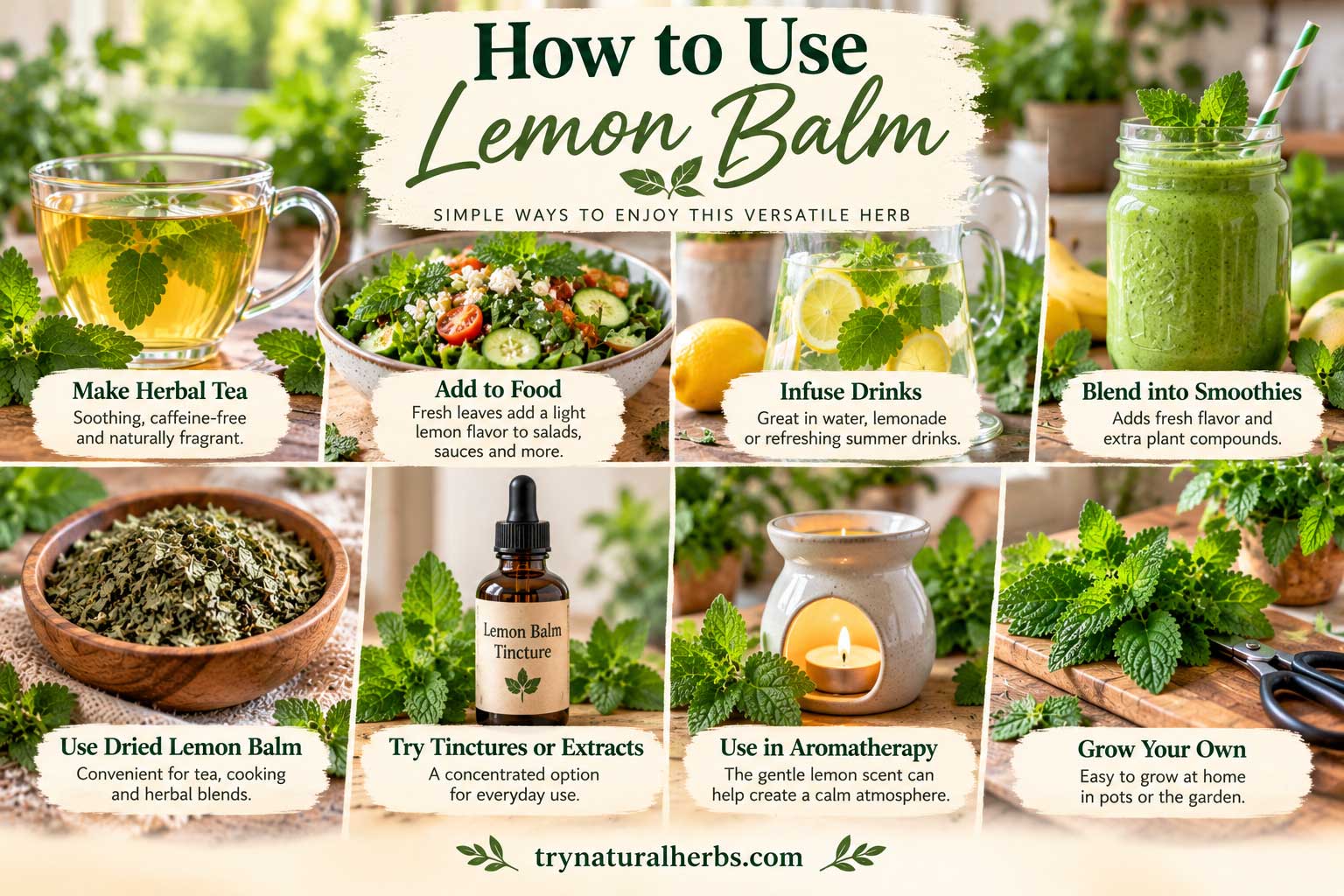
Lemon balm can be used fresh, dried, or in concentrated preparations. The right form depends largely on what you want to do with it: fresh leaves are excellent in food and drinks, dried leaves are convenient for tea, and commercial extracts and capsules provide more concentrated amounts.
Here are the most common ways to use Melissa officinalis:
| Form | Common Uses | What to Know |
|---|---|---|
| Fresh leaves | Salads, fruit, smoothies, infused water, desserts, garnish | Brightest lemon aroma and mildest flavor |
| Dried leaves | Herbal tea and tea blends | Convenient for year-round use |
| Tea | Hot or iced caffeine-free beverage | Easy to prepare from fresh or dried leaves |
| Tincture/liquid extract | Concentrated herbal preparation | Strength varies considerably between products |
| Capsules/tablets | Supplements | Follow the specific product’s serving directions |
| Topical preparations | Commercial creams and skin products | Use only as directed for the specific product |
| Essential oil | Primarily aromatherapy and properly diluted topical use | Highly concentrated; don’t treat it like the whole herb |
Using Fresh Lemon Balm
Fresh leaves have the brightest flavor and work especially well in:
- Fruit salads
- Green salads
- Smoothies
- Lemonade
- Sparkling water
- Yogurt
- Desserts
- Homemade iced tea
For the strongest aroma, gently crush or tear the leaves shortly before using them. Lemon balm’s flavor is delicate, so when cooking with it, adding the leaves toward the end usually preserves more of their fresh citrus character.
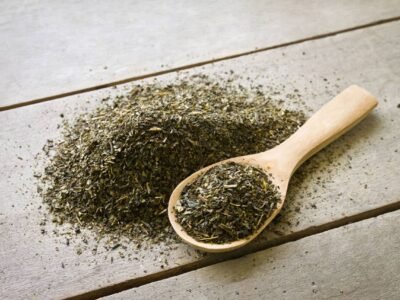
Using Dried Lemon Balm
Dried lemon balm is most commonly used for herbal tea. It can be brewed alone or combined with herbs such as chamomile, lavender, peppermint, spearmint, ginger, or lemon verbena.
Dried leaves gradually lose their aroma, so buy or dry amounts you’ll realistically use.
Using Extracts, Tinctures, and Capsules
Concentrated lemon balm products shouldn’t be treated as interchangeable with tea. A tincture, standardized extract, and capsule may contain very different amounts of plant material and active compounds.
Check the label for the amount per serving and follow the manufacturer’s directions. If you take medication or have a medical condition, review the safety and interaction information later in this guide before using concentrated lemon balm regularly.
What About Lemon Balm Essential Oil?
Lemon balm essential oil, often sold as Melissa essential oil, is a highly concentrated product primarily used in aromatherapy and diluted topical preparations.
Don’t apply undiluted essential oil directly to the skin, and don’t assume that an essential oil can be consumed simply because lemon balm leaves are edible. Keep essential oils away from the eyes and out of reach of children and pets.
How to Make Lemon Balm Tea
Lemon balm tea is one of the simplest ways to enjoy the herb. It has a mild lemony flavor, contains no caffeine naturally, and can be prepared with either fresh or dried leaves.
Ingredients
For one 8-ounce (240 ml) cup:
- 1–2 teaspoons dried lemon balm leaves, or
- 1–2 tablespoons loosely packed fresh leaves
- 8 ounces (240 ml) hot water
- Honey or lemon, optional
Instructions
- Place the lemon balm in a tea infuser, teapot, or mug.
- Pour freshly heated water over the leaves.
- Cover the cup or teapot while the tea steeps.
- Steep for 5–10 minutes.
- Strain and taste.
- Add honey or lemon if desired.
For a stronger flavor, use a little more herb or extend the steeping time rather than repeatedly reheating the leaves.
Fresh vs. Dried Leaves for Tea
Fresh lemon balm produces a lighter, brighter infusion with a noticeable citrus aroma. Dried lemon balm generally tastes more herbal and is much easier to keep on hand throughout the year.
If you’re using fresh leaves from your garden, gently bruise them before steeping to release more of their aroma.
Can You Make Iced Lemon Balm Tea?
Yes. Prepare the tea slightly stronger than usual, allow it to cool, and refrigerate it before serving over ice.
Fresh lemon balm, lemon slices, cucumber, berries, or a small amount of honey can be added for flavor.
Store homemade tea covered in the refrigerator and use it promptly rather than leaving an herbal infusion sitting at room temperature for long periods.
When Is the Best Time to Drink Lemon Balm Tea?
There’s no medically established “best” time.
Some people prefer lemon balm after meals because of its traditional digestive use, while others drink it in the evening because it’s caffeine-free and fits easily into a bedtime routine.
If you’re trying lemon balm for the first time, start with a modest amount and see how you respond, particularly before driving or doing anything requiring full alertness.
Fresh vs. Dried Lemon Balm
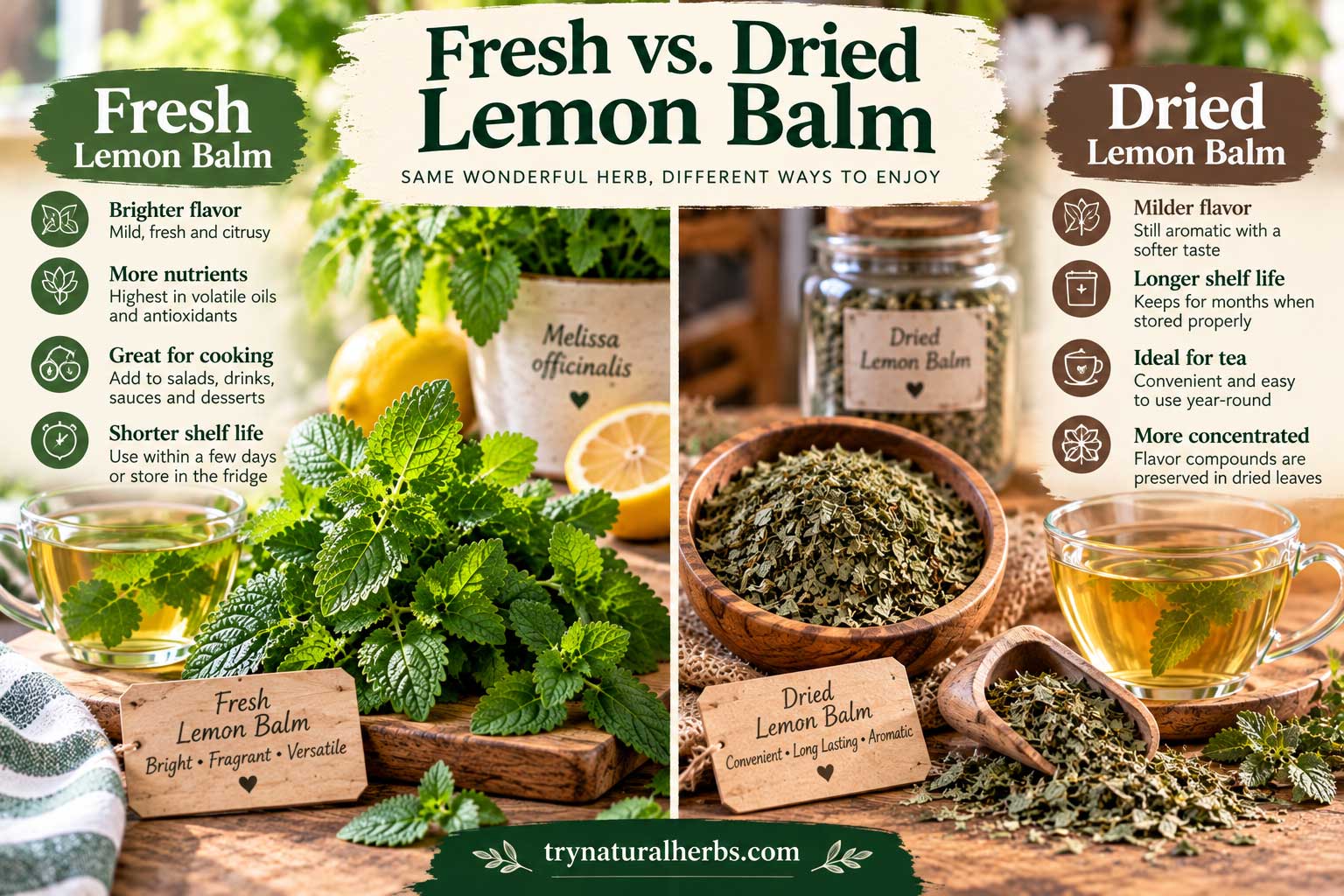
Fresh and dried lemon balm come from the same plant, but they aren’t identical in flavor, aroma, or convenience. Fresh leaves have the brightest lemon fragrance, while dried lemon balm is easier to store and is particularly useful for tea.
| Feature | Fresh Lemon Balm | Dried Lemon Balm |
|---|---|---|
| Flavor | Bright, delicate, lemony | More herbal and concentrated |
| Aroma | Fresh and strongly citrusy | Usually milder |
| Best for | Salads, drinks, desserts, garnish | Tea and herbal blends |
| Storage | Refrigerate and use relatively quickly | Store in an airtight container |
| Availability | Seasonal unless grown indoors | Available year-round |
| Convenience | Requires washing and preparation | Ready to measure and steep |
Drying removes water from the leaves and changes their aromatic profile. Some volatile compounds responsible for lemon balm’s fresh citrus fragrance can be lost during drying and storage, which is why freshly crushed leaves often smell noticeably stronger.
Other nonvolatile plant compounds may remain in dried material, but the exact amounts depend on factors such as drying temperature, storage conditions, and the age of the herb.
Which Is Better?
Choose fresh lemon balm when flavor and aroma matter most, especially for fruit, salads, cold drinks, desserts, and garnishes.
Choose dried lemon balm when you want something convenient for tea, herbal blends, or year-round storage.
There’s no need to think of one as inherently “healthier” than the other. The better choice depends on how you’re using the herb and how fresh the product is.
Lemon Balm Extracts and Supplements
Many studies investigating lemon balm haven’t used ordinary herbal tea. Instead, researchers have tested standardized extracts or other concentrated preparations, which makes understanding supplement labels especially important.
Lemon balm supplements are available as:
- Capsules and tablets
- Liquid extracts
- Alcohol-based tinctures
- Glycerin extracts
- Powders
- Combination herbal formulas
Combination products often pair lemon balm with herbs such as valerian, chamomile, lavender, or passionflower, particularly in products marketed for relaxation or sleep.
How to Choose a Lemon Balm Supplement
Look for a label that clearly identifies the herb as Melissa officinalis and tells you how much is provided per serving.
Other useful quality indicators include:
- A complete ingredient list
- Clear serving instructions
- Manufacturer contact information
- Lot or batch identification
- Independent third-party testing when available
Be skeptical of products claiming that lemon balm can cure anxiety, reverse dementia, treat thyroid disease, eliminate viruses, or replace prescription medication. Those claims aren’t supported by current evidence.
Standardized Extract vs. Whole Herb
A standardized extract is manufactured to provide a specified amount of a particular constituent or group of constituents. That can make research products more consistent, but it doesn’t automatically mean a standardized extract is “better” than whole lemon balm for every purpose.
It does mean that results from a trial using a particular extract shouldn’t automatically be applied to every lemon balm capsule, tincture, or cup of tea sold elsewhere.
Always follow the directions for the specific product you’re using rather than trying to copy a dose from an unrelated clinical study.
Lemon Balm Essential Oil
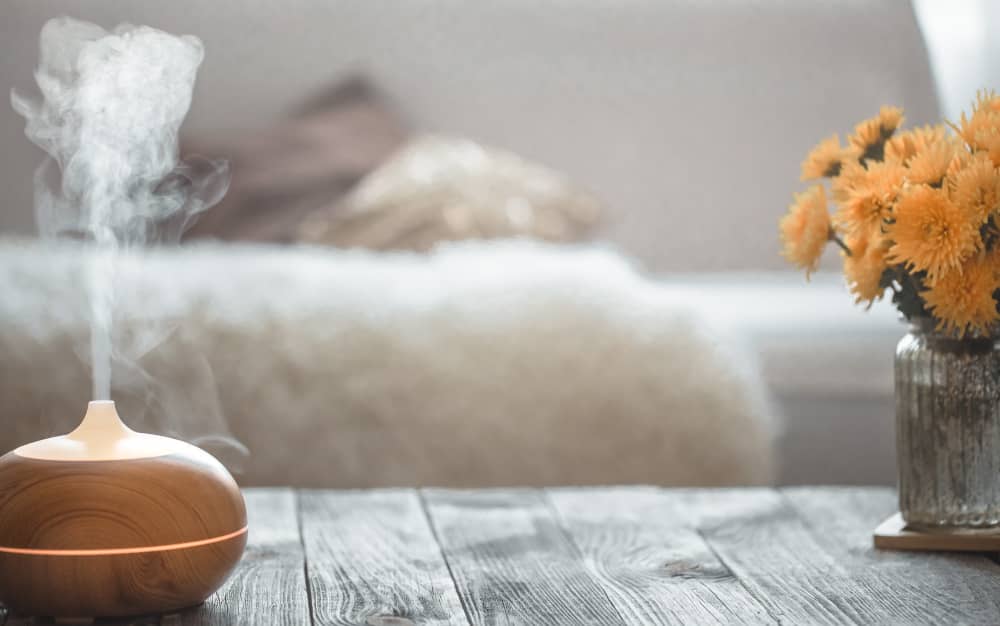
Lemon balm essential oil, usually sold as Melissa essential oil, is very different from lemon balm tea or a whole-herb supplement.
The oil is produced from the plant’s volatile aromatic compounds and is highly concentrated. Genuine Melissa essential oil can also be relatively expensive because the plant produces a comparatively small amount of essential oil.
It’s most commonly used for:
- Aromatherapy
- Diffusers
- Fragrance
- Properly formulated topical products
Essential Oil Safety
Don’t treat Melissa essential oil as though it were interchangeable with edible lemon balm leaves.
Avoid applying undiluted essential oil directly to the skin, keep it away from the eyes and mucous membranes, and store it securely away from children and pets. If you’re using it topically, follow the dilution and safety directions provided for the specific product.
Don’t ingest lemon balm essential oil as a DIY wellness practice. Essential oil is a highly concentrated preparation with a very different chemical profile and exposure level from lemon balm tea.
Also, don’t confuse lemon balm extract with lemon balm essential oil. The topical preparations studied for cold sores have generally involved specific Melissa officinalis extracts or formulated products; that doesn’t mean undiluted Melissa essential oil should be applied to a cold sore.
Culinary Uses and Recipes
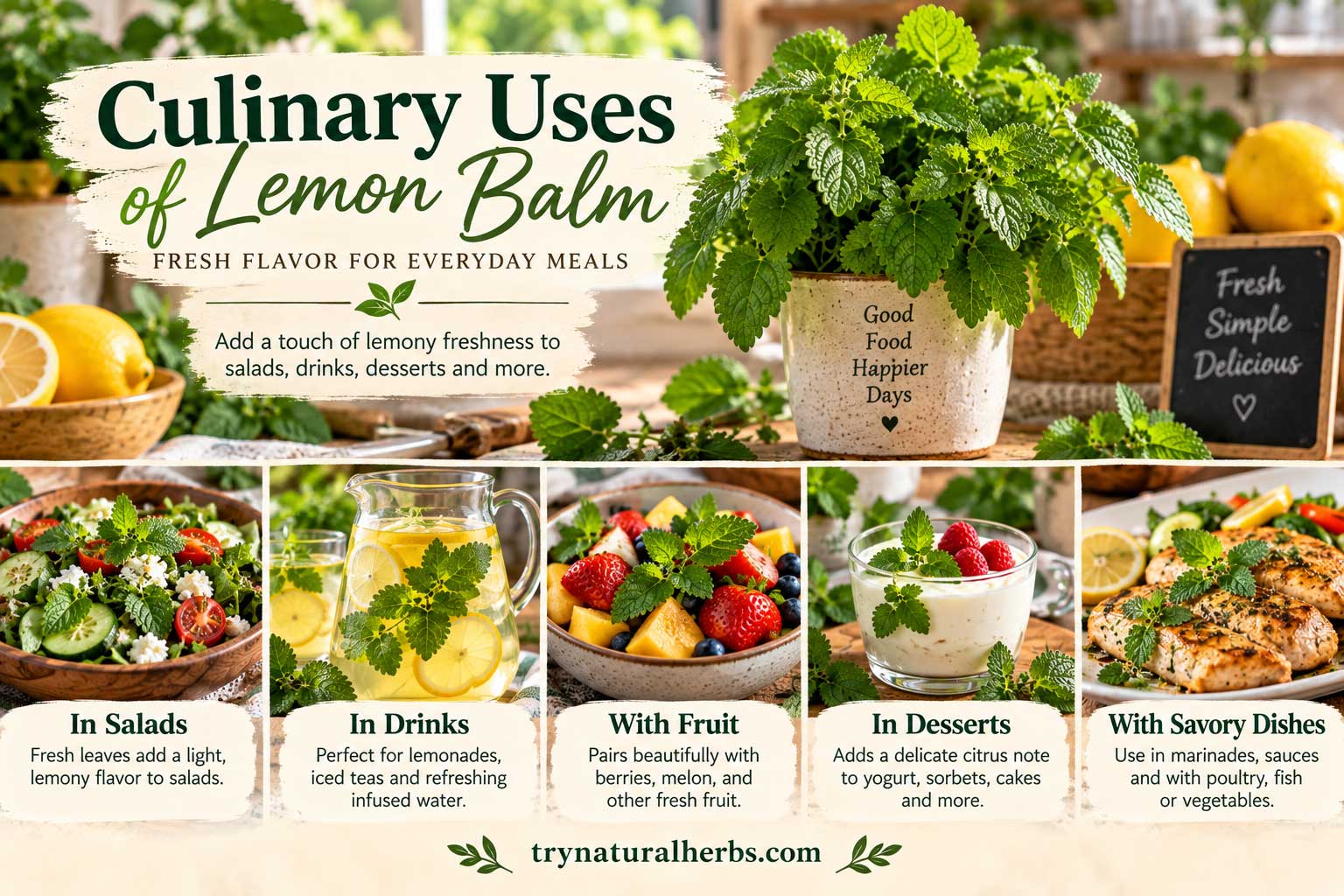
Lemon balm isn’t just an herbal remedy. The fresh leaves are edible and have a gentle lemon flavor with a hint of mint, making them surprisingly versatile in the kitchen.
Unlike lemon juice, lemon balm adds citrus aroma without adding much acidity. That makes it especially useful in dishes where you want a fresh lemon note without changing the texture or tartness.
Fresh leaves work particularly well with:
- Strawberries, peaches, melon, and other summer fruit
- Yogurt and oatmeal
- Green and grain salads
- Soft cheeses
- Chicken and fish
- Herb butter
- Smoothies
- Lemonade and infused water
- Iced herbal tea
- Desserts and fruit-based sauces
Lemon balm’s flavor is delicate and can fade during prolonged cooking. For hot dishes, try adding freshly chopped leaves toward the end rather than cooking them for a long time.
Simple Lemon Balm Lemonade
This is an easy way to use a handful of fresh leaves from the garden.
Ingredients
- 2 cups cold water
- Juice of 2 lemons
- 10–12 fresh lemon balm leaves
- 1–2 tablespoons honey or another sweetener, optional
- Ice
Directions
- Gently bruise or tear the lemon balm leaves.
- Combine the lemon juice, water, and sweetener.
- Add the lemon balm and refrigerate for about 20–30 minutes.
- Taste and remove the leaves when the flavor is strong enough for you.
- Serve over ice.
You can also add a few finely sliced leaves to a bowl of strawberries, blueberries, peaches, watermelon, or pineapple just before serving. Start with a small amount—the aroma is more noticeable once the leaves are cut or crushed.
How Much Lemon Balm Should You Use?
There isn’t one scientifically established dose of lemon balm that applies to every use.
That’s partly because lemon balm comes in very different forms. A handful of fresh leaves used in food, a cup of tea, a tincture, and a standardized clinical extract can contain very different concentrations of plant compounds.
Lemon Balm Tea
For an ordinary herbal infusion, a practical starting point is:
- Dried lemon balm: about 1–2 teaspoons per 8 ounces (240 ml) of water
- Fresh lemon balm: about 1–2 tablespoons of loosely packed leaves per 8 ounces (240 ml) of water
These amounts are for preparing tea, not medically established therapeutic doses.
There’s also no universal evidence-based number of cups that everyone should drink each day. If you enjoy lemon balm tea, start modestly and pay attention to how you respond, particularly because some people may experience drowsiness.
Extracts, Tinctures, and Capsules
This is where a universal “lemon balm dosage” becomes particularly misleading.
Clinical trials have used different extracts, concentrations, and doses for different purposes. A dose used with one standardized research extract may not be equivalent to the same number of milligrams from another commercial product.
For supplements, follow the directions for the specific formulation rather than copying a dosage from an unrelated study.
More isn’t necessarily better. Don’t increase the amount simply because an herbal product is described as natural.
Lemon Balm Side Effects and Safety
Lemon balm appears to be generally well tolerated when used in ordinary food amounts, and short-term studies of various preparations haven’t identified a pattern of severe adverse effects in most participants. However, concentrated supplements have been studied much less extensively over the long term.
Possible side effects reported with oral lemon balm preparations can include:
- Drowsiness
- Headache
- Dizziness
- Nausea
- Abdominal discomfort
Individual responses can vary, and the safety profile of a cup of tea shouldn’t automatically be assumed to be identical to that of a concentrated extract.
Can Lemon Balm Make You Sleepy?
Possibly. Some research has examined lemon balm specifically for its calming effects, and drowsiness can occur in some people.
Until you know how a concentrated lemon balm product affects you, use caution before driving, operating machinery, or combining it with other substances that cause sedation.
Topical Safety
Lemon balm-containing skin products can cause irritation or an allergic reaction in some people. Stop using a topical product if it causes persistent burning, swelling, rash, or worsening irritation.
Essential oil deserves additional caution because it is far more concentrated than the whole herb. Don’t apply undiluted Melissa essential oil directly to the skin.
How Long Can You Take Lemon Balm?
This is another area where the evidence isn’t strong enough for a universal answer.
Many human studies have been relatively short, so we know considerably less about continuous, long-term use of concentrated lemon balm supplements than we do about ordinary culinary use.
If you plan to take a concentrated extract regularly for an extended period—especially for a specific health concern—discuss it with a healthcare professional.
Food use and an occasional cup of tea are different from taking a high-strength supplement every day.
The next section covers the situations that require more caution, including sedating medications, thyroid treatment, pregnancy and breastfeeding, children, and surgery.
Lemon Balm Medication Interactions
Information about lemon balm drug interactions is limited, and not every interaction listed online has been demonstrated in human clinical studies. The greatest caution is warranted with concentrated extracts and supplements, rather than the small amounts normally used as a culinary herb.
The European herbal monograph also notes that data on interactions with other medicinal products are unavailable.
Sedatives and Other Medications That Cause Drowsiness
Because lemon balm has been studied for calming and sedating effects, combining concentrated lemon balm preparations with other substances that cause drowsiness could potentially increase sedation.
These may include:
- Prescription sleep medications
- Anti-anxiety or sedating medications
- Sedating antihistamines
- Other supplements or herbs with sedating effects
- Alcohol
The degree of interaction isn’t well established, but the combination deserves caution.
If you’re taking a medication that affects alertness, ask a pharmacist or healthcare professional before adding a concentrated lemon balm supplement.
Lemon Balm and Thyroid Medication
You’ll sometimes see warnings that lemon balm can interfere with thyroid function or thyroid medications. This concern comes largely from laboratory and preclinical research rather than strong evidence of a clinically significant interaction in humans.
This doesn’t establish that lemon balm interferes with thyroid medication in people, but the uncertainty is worth considering if you have a thyroid condition or take thyroid medication.
If you have a thyroid disorder or take thyroid medication, discuss regular use of concentrated lemon balm extracts or supplements with your healthcare professional.
Ordinary culinary use is a different level of exposure from taking a concentrated supplement every day.
Other Medications
Evidence for specific interactions between lemon balm and medications for blood pressure, diabetes, or other chronic conditions is currently too limited to make confident claims about individual drug interactions.
Rather than assuming an interaction exists—or that a combination is safe—check with a pharmacist or healthcare professional if you take prescription medications and plan to use lemon balm supplements regularly.
This is particularly important when taking several medications or combining multiple herbal supplements.
Before Surgery
Because herbal supplements can potentially affect sedation or interact with medications used around surgery, tell your surgical team about all supplements and herbal products you use.
Follow their instructions about when to stop them before a procedure rather than relying on a universal rule for lemon balm.
Pregnancy, Breastfeeding, and Children
Safety information for concentrated lemon balm preparations during pregnancy and breastfeeding is limited. The same is true for routine medicinal use in children.
That doesn’t mean lemon balm has been proven dangerous in these groups. It means there isn’t enough good evidence to confidently establish the safety of concentrated or medicinal use.
Pregnancy
Using lemon balm occasionally as a culinary herb isn’t the same as taking a concentrated extract, tincture, capsule, or essential oil.
Because adequate safety data for medicinal amounts during pregnancy are lacking, avoid self-prescribing concentrated lemon balm products during pregnancy without discussing them with a healthcare professional.
Breastfeeding
There also isn’t enough reliable evidence to establish the safety of concentrated lemon balm supplements during breastfeeding.
If you’re breastfeeding and considering regular lemon balm supplementation, discuss the specific product with your healthcare professional.
Children
Lemon balm has appeared in some research involving children, including studies of herbal combinations. However, that doesn’t establish a universal safe dose for every lemon balm product or every age group.
Children shouldn’t simply be given a scaled-down version of an adult supplement dose.
For medicinal use in a child, particularly concentrated extracts, tinctures, capsules, or essential-oil products, consult a pediatric healthcare professional.
How to Grow Lemon Balm
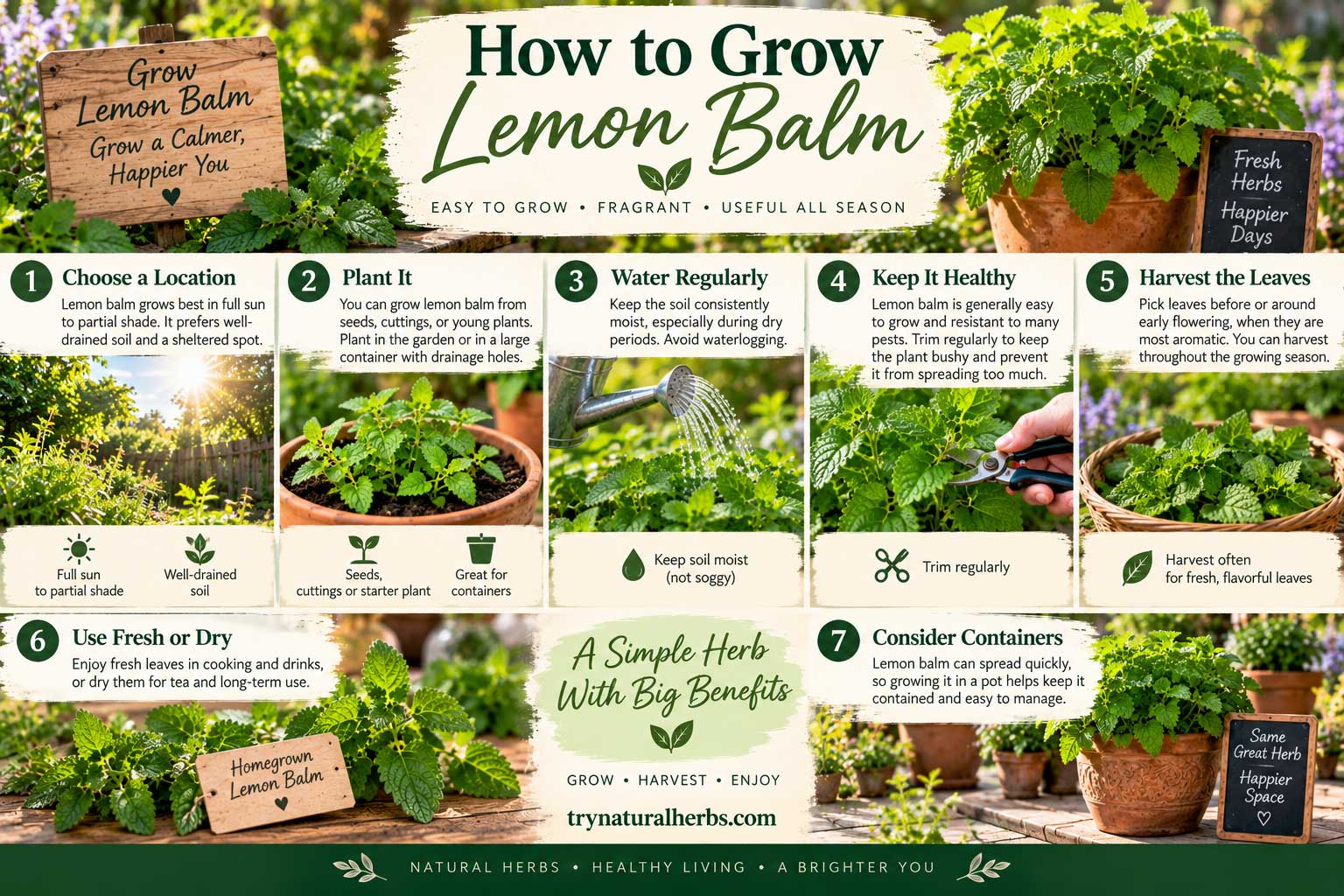
Lemon balm is one of the easier herbs to grow at home. Once established, this perennial member of the mint family can produce fresh, fragrant leaves from spring through autumn and return for multiple growing seasons in suitable climates.
It’s also an enthusiastic grower. If you don’t want lemon balm spreading through a garden bed, a container can make it much easier to control.
Lemon Balm Growing Conditions
| Growing Requirement | Recommendation |
|---|---|
| USDA hardiness | Commonly grown as a perennial in Zones 4–9 |
| Light | Full sun to partial shade |
| Soil | Well-drained soil |
| Soil pH | Roughly 6.0–7.5 |
| Water | Regular moisture while establishing; avoid persistently waterlogged soil |
| Typical height | About 12–36 inches (30–90 cm) |
| Spacing | Roughly 18–24 inches (45–60 cm) |
Lemon balm can tolerate a range of conditions, so don’t worry about creating a perfect growing environment. Good drainage, adequate light, and reasonable moisture are more important than obsessing over exact numbers.
Planting Lemon Balm
Lemon balm can be started from seed, purchased as a young plant, or propagated by division or cuttings.
If planting outdoors, wait until the risk of a hard spring frost has passed before setting out tender young plants.
Space plants approximately 18–24 inches apart so they have room to fill out. Container-grown lemon balm should have drainage holes and enough space for the root system to develop.
During the first growing season, water consistently enough to keep young plants from drying out completely. Once established, lemon balm is fairly forgiving.
Keeping Lemon Balm Under Control
This is something worth knowing before you plant it.
Lemon balm can spread by seed and gradually occupy more garden space than expected. If you want plenty of leaves but don’t want seedlings appearing elsewhere, remove flower heads before they set seed.
Growing lemon balm in a pot is another easy option.
Regular trimming also encourages fresh, bushy growth instead of long, floppy stems.
Harvesting and Drying Lemon Balm
You don’t need to wait for a lemon balm plant to reach a precise height before taking a few leaves. Once the plant is established and growing vigorously, you can harvest small amounts as needed.
For a larger harvest intended for drying, many gardeners prefer cutting the plant before or around the beginning of flowering, when the leaves are still strongly aromatic.
How to Harvest Lemon Balm
For the best-quality leaves:
- Choose healthy growth without obvious disease or insect damage.
- Harvest after surface moisture or morning dew has dried.
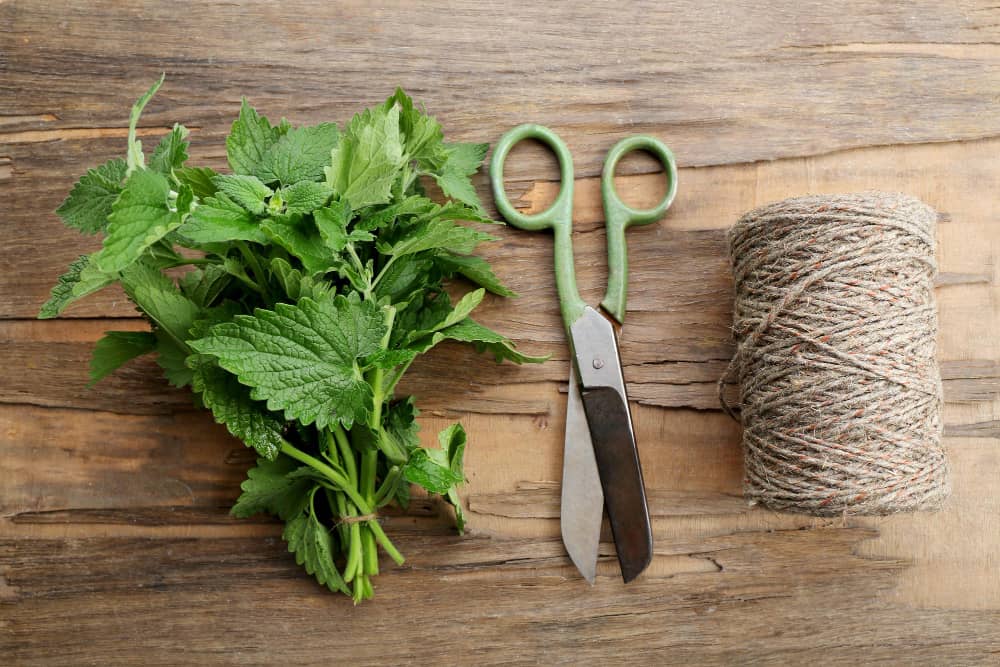
- Cut stems with clean scissors or pruning shears.
- Leave enough healthy growth for the plant to recover.
- Handle the leaves gently to preserve their aroma.
You can continue harvesting throughout the growing season. Cutting stems back periodically often stimulates another flush of tender leaves.
If you’re harvesting lemon balm for food or tea, avoid plants that have been sprayed with products not intended for edible crops.
How to Air-Dry Lemon Balm
Air-drying works well if your environment is warm, dry, and well ventilated.
- Remove damaged or discolored leaves.
- Gather the stems into small, loose bundles rather than one large bunch.
- Hang them in a dry, well-ventilated location away from direct sunlight.
- Allow the leaves to dry until they feel crisp rather than soft or leathery.
- Strip the dried leaves from the stems and transfer them to an airtight container.
Drying time varies with humidity, airflow, temperature, and bundle size, so use the condition of the leaves rather than an exact number of days to determine when they’re finished.
Drying Lemon Balm in a Dehydrator
A dehydrator is useful when humidity makes air-drying difficult.
Spread the leaves in a single layer and use a low herb-drying temperature, following the instructions for your particular dehydrator. Dry them until they are crisp and no longer retain noticeable moisture.
Using excessive heat can reduce the delicate aroma that makes lemon balm distinctive.
How to Store Dried Lemon Balm
Once the leaves are completely dry, store them in an airtight container in a cool, dark, dry place.
Glass jars, food-safe tins, and other moisture-resistant containers work well.
For better flavor, keep the leaves relatively whole during storage and crush them when you’re ready to make tea. This reduces the amount of surface area exposed to air.
Label home-dried lemon balm with the harvest date so you know how old it is.
Properly dried herbs can remain usable for quite some time, but aroma and flavor gradually fade. Rather than assuming lemon balm suddenly “expires” at exactly one year, replace it when the leaves have lost most of their characteristic lemon fragrance, flavor, or overall quality.
How to Store Fresh Lemon Balm
Fresh lemon balm is best used soon after harvesting because its distinctive citrus aroma gradually fades during storage.
If you’re not using it immediately, keep the leaves dry until needed. Loosely wrap the stems in a slightly damp paper towel, place them in a container or storage bag, and refrigerate.
Check the leaves before using them and discard any that have become slimy, moldy, or noticeably spoiled rather than relying solely on a fixed number of storage days.
Can You Freeze Lemon Balm?
Yes. Freezing is a useful option when you have more fresh lemon balm than you can use at once.
You can:
- Freeze clean, dry leaves in a freezer-safe container or bag.
- Chop the leaves before freezing them in small portions.
- Freeze chopped lemon balm in ice-cube trays with water for drinks.
- Freeze it in small portions with oil when you intend to use it in cooked dishes.
Frozen leaves won’t retain the same crisp texture as fresh lemon balm, so they’re better suited to smoothies, drinks, sauces, soups, and cooked recipes than salads or garnishes.
For tea, drying the leaves is usually more convenient and takes up less freezer space.
Lemon Balm vs. Mint
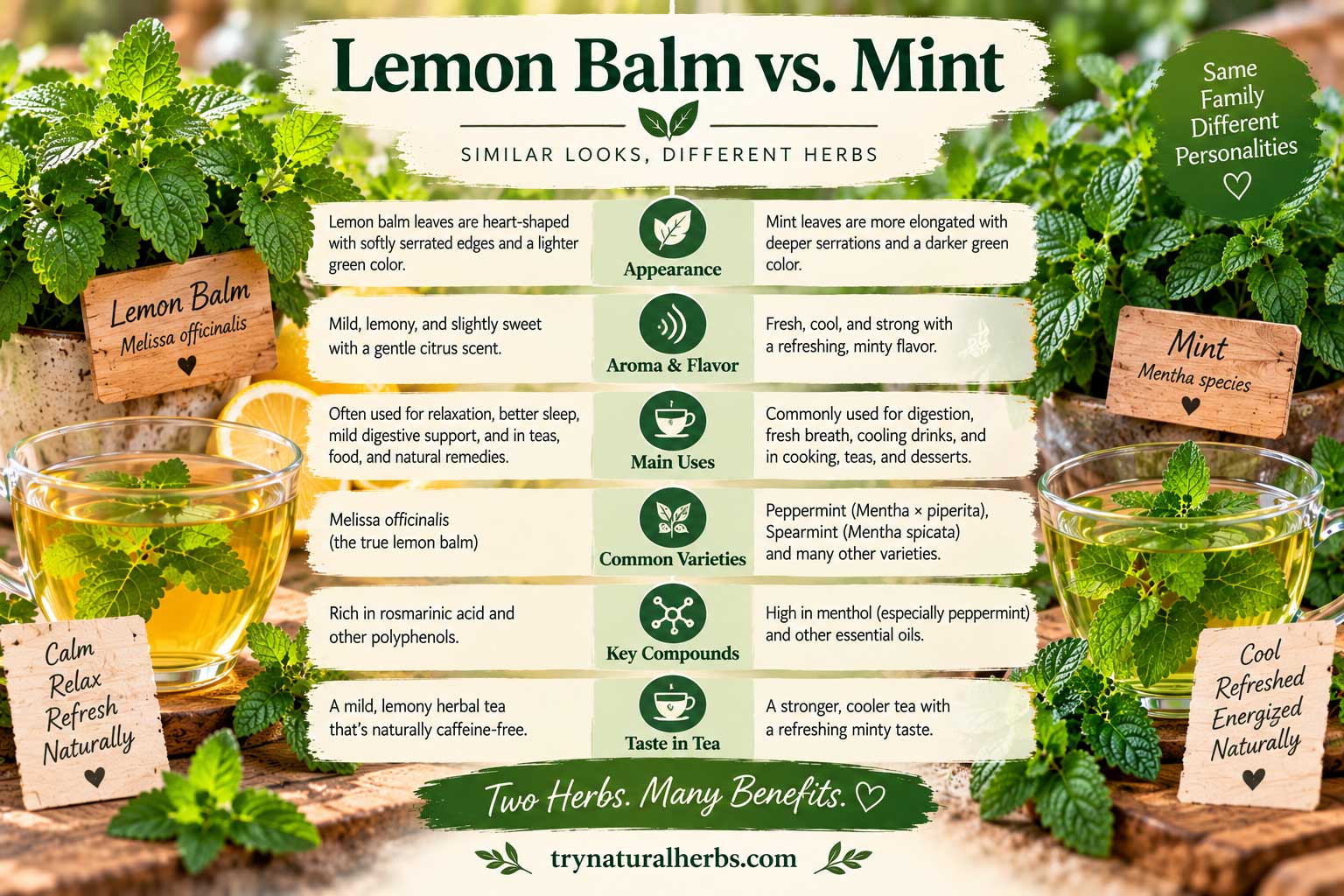
Lemon balm is a member of the mint family, but it isn’t the same plant as peppermint or spearmint.
In everyday conversation, “mint” often refers to plants in the genus Mentha, particularly peppermint (Mentha × piperita) and spearmint (Mentha spicata). Lemon balm belongs to a different genus: Melissa.
| Feature | Lemon Balm | Peppermint | Spearmint |
|---|---|---|---|
| Botanical name | Melissa officinalis | Mentha × piperita | Mentha spicata |
| Plant family | Lamiaceae | Lamiaceae | Lamiaceae |
| Dominant flavor | Lemon-herbal | Strong, cooling mint | Sweeter, softer mint |
| Aroma | Citrusy | Intense menthol-like aroma | Fresh, sweet mint |
| Leaves | Broad, wrinkled, softly textured | Darker green, often pointed | Green, pointed leaves |
| Common culinary uses | Tea, fruit, desserts, drinks | Tea, chocolate, desserts, drinks | Tea, sauces, salads, savory dishes |
| Caffeine naturally present | No | No | No |
What Does Lemon Balm Taste Like?
If you’re expecting the cooling sensation of peppermint, lemon balm may surprise you.
Its flavor is softer and more citrus-forward, with only a mild herbal character reminiscent of other members of the mint family. It doesn’t contain the same prominent menthol character associated with peppermint.
That makes lemon balm particularly good with fruit, lemonade, iced tea, and lighter desserts.
Peppermint is the better choice when you want a strong cooling mint flavor, while spearmint works especially well when you want something sweeter and less intense.
All three can spread vigorously in the garden, so containers are worth considering if you want to keep them under control.
Lemon Balm vs. Lemon Verbena
Lemon balm and lemon verbena may smell similar at first, but they’re unrelated herbs with noticeably different flavors, appearances, and growing habits.
Lemon balm (Melissa officinalis) belongs to the mint family. Lemon verbena (Aloysia citrodora) belongs to the verbena family and originates from South America.
| Feature | Lemon Balm | Lemon Verbena |
|---|---|---|
| Botanical name | Melissa officinalis | Aloysia citrodora |
| Plant family | Lamiaceae (mint family) | Verbenaceae (verbena family) |
| Growth | Herbaceous perennial | Woody shrub |
| Flavor | Soft lemon with herbal notes | Strong, clean lemon |
| Leaves | Broad, wrinkled, soft | Long, narrow, firmer |
| Aroma | Gentle lemon-mint fragrance | Intense lemon fragrance |
| Cold tolerance | Relatively cold-hardy | Much more cold-sensitive |
| Common uses | Tea, fruit, salads, drinks | Tea, desserts, syrups, drinks |
Which One Is Better for Tea?
Both make excellent caffeine-free herbal teas, but they taste noticeably different.
Choose lemon balm if you want a softer, slightly herbal lemon flavor. Choose lemon verbena if you want a stronger aroma that tastes much closer to lemon itself.
They’re also excellent together. Lemon verbena can provide the stronger citrus note while lemon balm adds a softer herbal character.
Which One Is Easier to Grow?
In colder climates, lemon balm is generally the easier plant to keep outdoors as a perennial because it tolerates winter temperatures much better.
Lemon verbena prefers warmer conditions and may need winter protection, indoor overwintering, or treatment as an annual in colder regions.
Lemon balm has the opposite gardening problem: rather than struggling to survive, it can spread more aggressively than expected.
FAQs About Lemon Balm
What is lemon balm good for?
Lemon balm (Melissa officinalis) is traditionally used for relaxation, sleep, and digestive comfort. Modern research has also investigated standardized lemon balm preparations for stress, cognitive performance, and topical use for cold sores, although the strength of evidence varies considerably between these uses.
Does lemon balm help with anxiety?
Small human studies suggest that certain lemon balm extracts may promote calmness or reduce some measures of stress and anxiety-related symptoms. However, the research is limited, and lemon balm hasn’t been established as a treatment for anxiety disorders.
Does lemon balm make you sleepy?
It can cause drowsiness or promote feelings of relaxation in some people, particularly in concentrated preparations. Lemon balm shouldn’t be considered a sleeping pill, but its caffeine-free tea can fit naturally into an evening routine.
Can you drink lemon balm tea every day?
There isn’t a universal evidence-based recommendation for how many cups of lemon balm tea everyone should drink each day. Moderate culinary and tea use is different from taking concentrated extracts regularly, so start modestly and consider your medications and individual health circumstances.
When is the best time to drink lemon balm tea?
There is no medically established best time. Some people drink it after meals because of its traditional digestive use, while others prefer it in the evening because it’s naturally caffeine-free.
How long does lemon balm take to work?
There isn’t one reliable timeframe because it depends on the preparation and reason for using it. Some clinical studies of standardized extracts have examined short-term effects within hours, while other research has involved repeated use over days or weeks. Those findings shouldn’t be used to predict exactly how quickly homemade tea will affect you.
Who should be cautious with lemon balm?
Extra caution is appropriate for people taking sedating medications or thyroid medications and for those who are pregnant, breastfeeding, preparing for surgery, or considering medicinal use in children. If you take prescription medication, check with a healthcare professional before regularly using concentrated lemon balm supplements.
Is lemon balm safe for the thyroid?
Human evidence on lemon balm and thyroid function is limited. Because laboratory and preclinical research has raised questions about possible thyroid effects, people with thyroid conditions or those taking thyroid medication should discuss regular use of concentrated lemon balm products with a healthcare professional.
Does lemon balm contain caffeine?
No. Pure lemon balm leaves are naturally caffeine-free. Check the ingredients in commercial tea blends, however, because lemon balm may be combined with tea leaves or other caffeine-containing ingredients.
Can you eat fresh lemon balm leaves?
Yes. Fresh lemon balm leaves are edible and can be used in salads, fruit dishes, smoothies, lemonade, infused water, desserts, and herbal tea.
Is lemon balm the same as mint?
No. Lemon balm belongs to the mint family (Lamiaceae), but it isn’t peppermint or spearmint. Its flavor is softer and more citrus-like, without peppermint’s characteristic cooling intensity.
Does drying lemon balm reduce its beneficial compounds?
Drying changes the herb’s chemical profile. Some volatile aromatic compounds can decrease during drying and storage, while other plant compounds remain. The final composition depends on factors such as drying temperature, storage conditions, and how long the herb has been stored.
Is lemon balm easy to grow?
Yes. Lemon balm is a vigorous perennial that tolerates a range of growing conditions and can produce plenty of leaves once established. In fact, the bigger gardening challenge is often keeping it from spreading farther than intended.
Does lemon balm attract bees?
Yes. Lemon balm’s small flowers attract bees and other pollinators. Its botanical name Melissa is even connected to the Greek word for honeybee, reflecting the plant’s long association with bees.
Is Lemon Balm Worth Trying?
Lemon balm (Melissa officinalis) has survived centuries of changing herbal traditions for a good reason: it’s genuinely useful.
You can brew the leaves into a caffeine-free tea, add fresh lemon balm to food and drinks, grow it with relatively little effort, or simply enjoy its distinctive citrus fragrance in the garden.
Its potential health effects require a little more perspective. Research into lemon balm benefits is most interesting in areas such as stress and relaxation, sleep, cognitive performance, and topical preparations for cold sores. But the evidence isn’t equally strong for every use, and findings from standardized extracts shouldn’t automatically be applied to homemade tea.
That’s really the key to using lemon balm sensibly: match the claim to the evidence and the preparation to the purpose.
For everyday culinary use, lemon balm is a flavorful and versatile herb. If you’re considering concentrated extracts or supplements for a health concern, pay closer attention to dosage, product quality, possible medication interactions, and the limitations of the available research.
And if you decide to grow your own, don’t be surprised when one small lemon balm plant turns into considerably more lemon balm than you planned for.